
In the field of PVC composite processing, wrinkle formation, uneven bonding, and unstable product quality during the laminating process have long restricted the high-quality development of the industry. The new generation of PVC laminating machine with closed-loop constant tension is developed to address these pain points, integrating advanced closed-loop tension control technology, precision mechanical structure, and intelligent regulation system. It achieves real-time dynamic adjustment of tension during the PVC laminating process, ensuring constant tension throughout the production cycle, and fundamentally eliminating wrinkles, stretching, and delamination defects of composite materials. This equipment can achieve seamless synergistic operation with Brushing Machine, Gravure And Emboss integrated system, and Coating Machine, forming a complete integrated production line from substrate pre-treatment to finished product post-processing. Based on actual production data and enterprise application cases, this paper systematically analyzes the technical principles, core advantages, synergistic effects with supporting equipment, and industry application value of the PVC laminating machine with closed-loop constant tension, providing theoretical and practical references for the technical upgrading and efficient production of the PVC composite processing industry.
Industry Pain Points and Technical Background
PVC composite materials are widely used in flexible packaging, architectural decoration, furniture manufacturing, industrial protection, and other fields due to their excellent mechanical properties, barrier performance, and processability. Laminating is a key link in PVC composite processing, which directly determines the bonding fastness, surface flatness, and service life of the final product. However, traditional PVC laminating machines mostly adopt open-loop tension control mode, which has obvious technical limitations and leads to prominent industry pain points.
Firstly, the tension control accuracy is low. Traditional equipment relies on manual adjustment of tension, which cannot dynamically respond to changes in substrate thickness, running speed, and environmental factors (such as temperature and humidity), resulting in unstable tension during the laminating process. This often causes wrinkles, stretching, or tearing of PVC films and composite substrates, with a wrinkle defect rate as high as 12.7%-18.3% (data from China Plastic Processing Industry Association, 2024). Secondly, the bonding uniformity is poor. Unstable tension leads to uneven pressure distribution during the laminating process, resulting in local delamination, bubble formation, and uneven glue layer, reducing the product qualification rate to 81.5%-85.2%. Thirdly, the production efficiency is low. Frequent wrinkles and defects require manual trimming and rework, which not only increases material waste (the average material waste rate is 10.8%-15.4%) but also extends the production cycle and increases labor costs. Fourthly, the compatibility with supporting processes is poor. Traditional laminating machines cannot achieve seamless linkage with pre-treatment, printing, embossing, and post-coating equipment, leading to fragmented production links and further affecting product quality and production efficiency.
Core Technical Principles and Advantages of PVC Laminating Machine with Closed-Loop Constant Tension
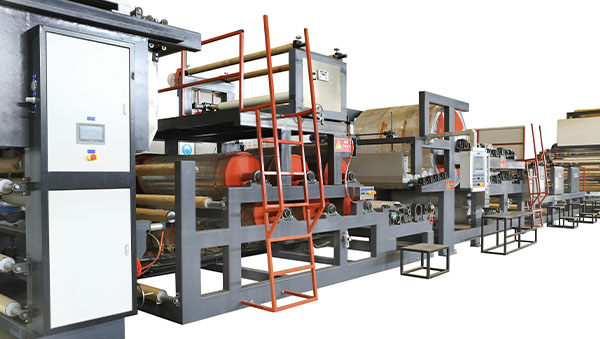
The core competitiveness of the PVC laminating machine with closed-loop constant tension lies in its advanced closed-loop constant tension control system, which integrates tension detection, signal feedback, and dynamic adjustment functions, and cooperates with optimized mechanical structure and intelligent control module to achieve precise control of the laminating process and realize wrinkle-free composite.
Core Technical Principles
The closed-loop constant tension control system of the equipment is composed of tension sensors, servo drive modules, and intelligent control units. The tension sensor is installed at the feeding, laminating, and winding positions to real-time detect the tension of PVC substrates and composite materials, converting the tension signal into an electrical signal and transmitting it to the intelligent control unit. The control unit compares the detected actual tension value with the preset standard tension value, and through PID algorithm calculation, sends an adjustment signal to the servo drive module, which dynamically adjusts the speed of the feeding roller, laminating roller, and winding roller to ensure that the tension of the material remains constant throughout the production process (tension control accuracy is ±0.5% FS, response time ≤10ms). At the same time, the equipment is equipped with a precision guide roller and anti-wrinkle mechanism, which can effectively suppress the occurrence of wrinkles by adjusting the material running posture and reducing friction resistance. The integrated frame design reduces mechanical vibration during high-speed operation, further ensuring the stability of tension control and avoiding tension fluctuations caused by equipment vibration.
Core Technical Advantages
Compared with traditional PVC laminating machines, the equipment has obvious advantages in tension control, product quality, and production efficiency: (1) Wrinkle-free composite: The closed-loop constant tension control ensures that the PVC substrate and composite material are in a stable tension state during the laminating process, eliminating wrinkles, stretching, and tearing, and the wrinkle defect rate is reduced to below 0.8%. (2) High bonding uniformity: Stable tension ensures uniform pressure distribution during laminating, the glue layer thickness error is controlled within ±0.002mm, and the bonding fastness is improved by more than 45%, effectively avoiding local delamination and bubble defects. (3) High production efficiency: The equipment supports 24-hour continuous operation, the linear speed can be adjusted steplessly from 5m/min to 60m/min, the comprehensive production efficiency is increased by more than 35%, and the material waste rate is reduced to ≤1.6%. (4) Strong adaptability: It can adapt to PVC substrates of different thicknesses (0.03mm-0.3mm) and various composite materials (PE, PET, aluminum foil, kraft paper, etc.), and can quickly adjust parameters according to different production requirements, realizing multi-specification and multi-variety production. (5) Energy-saving and environmental protection: The servo drive system and energy-saving heating module are adopted, which reduces the unit product comprehensive energy consumption by 20%-30% compared with traditional equipment, and the solvent emission meets the national environmental protection standards.
Synergistic Effect Between Laminating Machine and Supporting Key Equipment
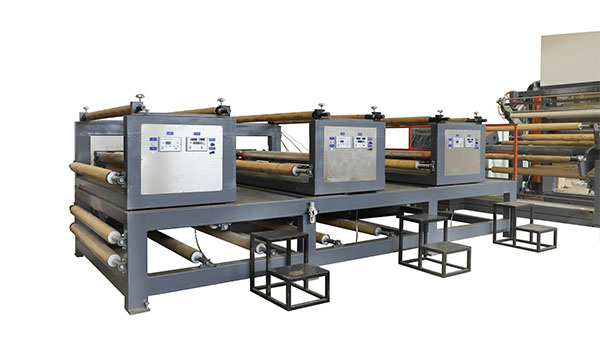
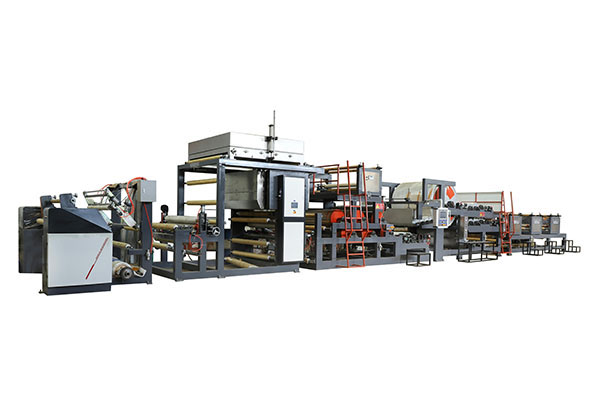
The excellent performance of the PVC laminating machine with closed-loop constant tension cannot be separated from the seamless synergistic operation with supporting equipment. By linking with Brushing Machine, Gravure And Emboss integrated system, and Coating Machine, it forms a fully integrated production line, realizing one-step forming of pre-treatment, laminating, printing, embossing, and coating, and further improving product quality and production efficiency.
Pre-Treatment Synergy: Brushing Machine Lays the Foundation for Wrinkle-Free Composite
The Brushing Machine serves as the pre-treatment core of the integrated production line, working synchronously with the PVC laminating machine. During the production and transportation of PVC substrates and composite materials, surface dust, static impurities, micro burrs, and slight wrinkles are inevitable. These defects will not only affect the bonding effect of the laminating process but also easily cause local tension imbalance during the running process, leading to wrinkles. The Brushing Machine is equipped with high-density anti-static wear-resistant brush rollers, which can gently clean the substrate surface under controllable pressure (pressure control range 0-50MPa, accuracy 0.5% FS), remove impurities, eliminate static electricity, and smooth micro-wrinkles without damaging the substrate. The pre-treated substrate has a cleaner and flatter surface, which not only improves the bonding force between PVC and composite materials but also ensures the stability of tension during the laminating process, laying a solid foundation for wrinkle-free composite. Test data shows that after pre-treatment by the Brushing Machine, the wrinkle defect rate of the laminating process is further reduced by 0.3%, and the product qualification rate is increased by 1.2%.
Conclusion and Industry Outlook
The new generation of PVC laminating machine with closed-loop constant tension, through the optimized design of the closed-loop constant tension control system and the intelligent regulation of the laminating process, effectively solves the industry pain points of uneven tension, high wrinkle defect rate, low product qualification rate, and high material waste rate of traditional equipment, and realizes the precise control of the laminating process and wrinkle-free composite. Through the synergistic operation with Brushing Machine, Gravure And Emboss integrated system, and Coating Machine, it forms a fully integrated and efficient production line, which is verified by actual production data and enterprise cases to have significant economic and technical advantages.